



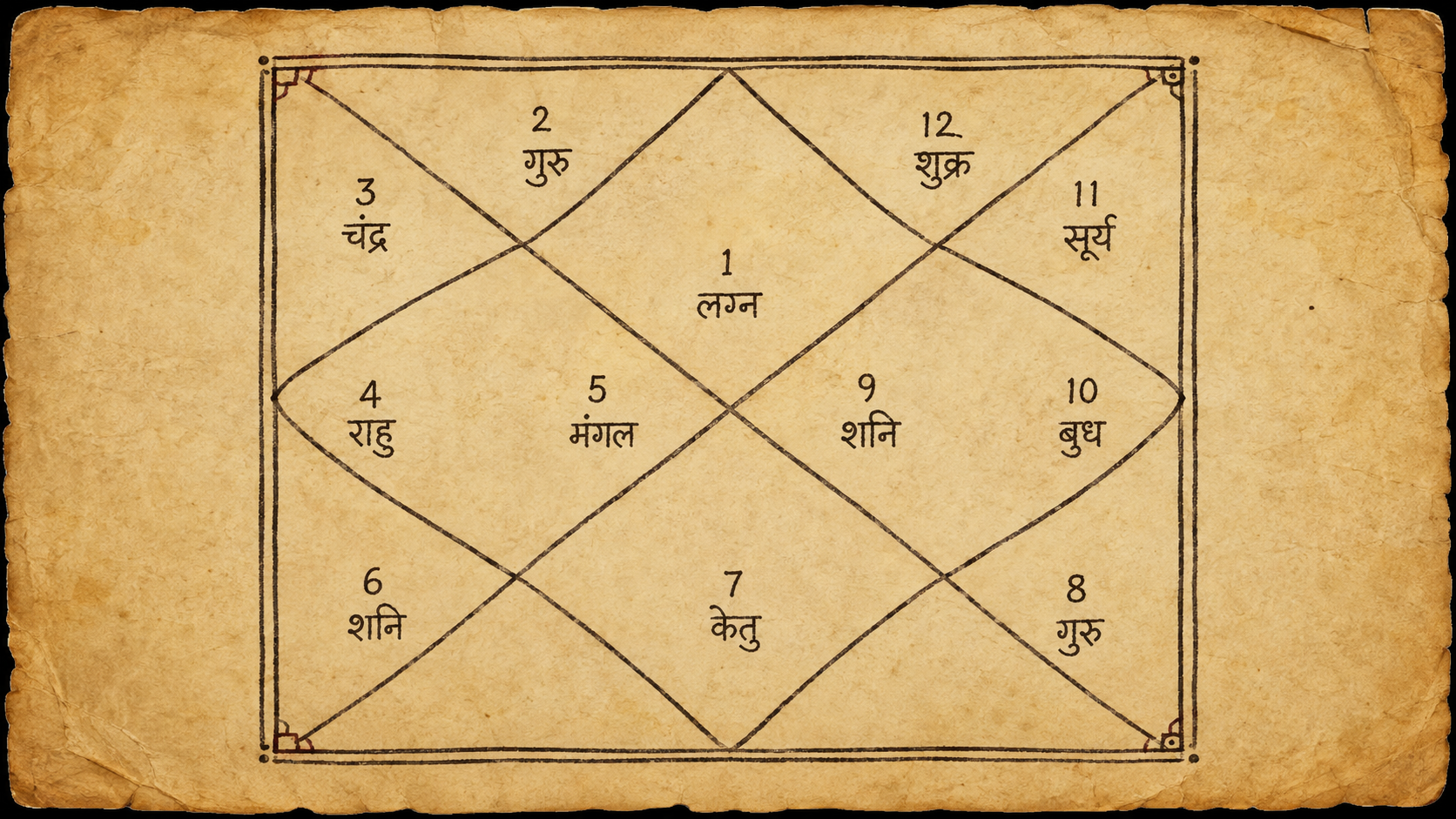
Ask ten people what Vedic astrology is and you will get ten different answers. Some call it an ancient science handed down unchanged for ten thousand years. Others dismiss it as superstition. The truth sits somewhere in between, and it is more interesting than either version.
This post explains what Vedic astrology really is, where it came from, how it works, and what it can and cannot do. No hype, no hand-waving.
The name itself is newer than you think
In India, the tradition is called Jyotisha, which roughly means "the science of light." The phrase "Vedic astrology" only became popular in the late twentieth century, partly as a way to distinguish the Indian system from Western astrology for a global audience.
Jyotisha began as one of the six Vedangas, the auxiliary disciplines attached to the Vedas. Its original job was practical: tracking the sun, moon, and stars so priests could time rituals correctly. The earliest surviving text, the Vedanga Jyotisha, is a calendar manual. It contains no birth charts, no predictions about marriage or career, and no zodiac signs.
Where the birth chart came from
Here is the part most astrology websites skip. Horoscopic astrology, the practice of casting a chart for the moment of birth, entered India roughly in the second century CE through contact with the Greek-speaking world. One of the key early texts, the Yavanajataka, literally means "the sayings of the Greeks."
Indian astronomers did not simply copy this material. They reworked it, merged it with their own older star lore, and built something distinct. Over the following centuries, texts like the Brihat Parashara Hora Shastra organized the system into the form practiced today. So Vedic astrology is genuinely old and genuinely Indian in its development, but it is a blend, not an unbroken revelation from the Vedic seers.
Does that make it less authentic? Not really. Every living tradition absorbs and transforms outside ideas. But knowing this history helps you spot the exaggerated claims.
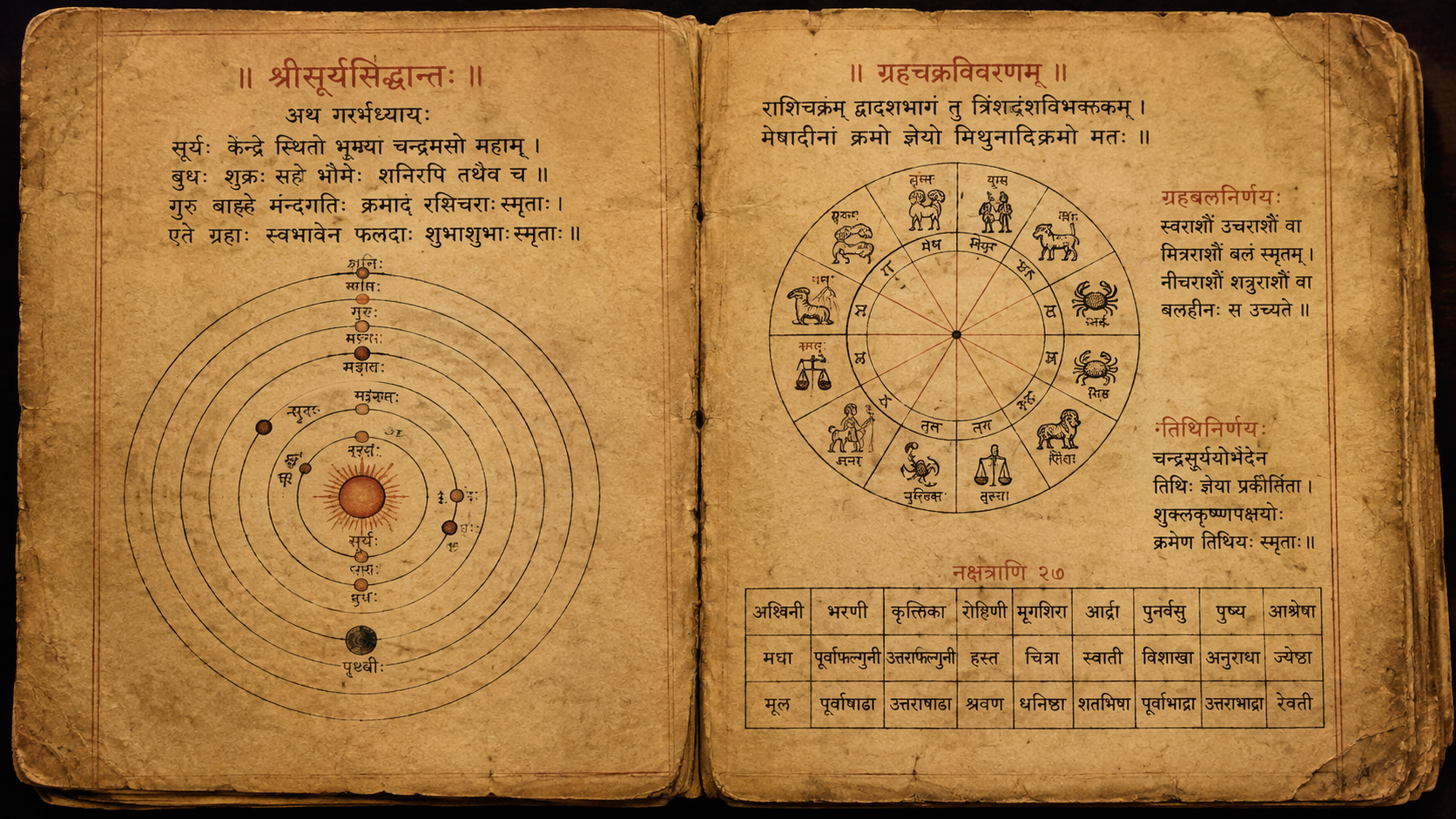
Classical Jyotisha texts were copied and commented on for centuries.
The sidereal zodiac: the biggest difference from Western astrology
Western astrology uses the tropical zodiac, which is tied to the seasons. Vedic astrology uses the sidereal zodiac, which is tied to the actual positions of the stars.
These two zodiacs matched about 1,700 years ago. Because of a slow wobble in the Earth's axis called precession, they have drifted apart by roughly 24 degrees. The gap is called the ayanamsa, and it grows by about one degree every 72 years.
The practical result surprises many people: if you are a Leo in Western astrology, your Vedic chart probably calls you a Cancer. Neither system is "wrong" on this point. They are measuring different things and were designed with different logic.
What is inside a Vedic chart
A Vedic birth chart, called a kundli or janma patrika, is built from the date, time, and place of birth. Its main working parts are:
- Twelve rashis (signs) and twelve bhavas (houses), covering areas of life such as family, work, health, and relationships.
- Nine grahas, usually translated as planets: the Sun, Moon, Mars, Mercury, Jupiter, Venus, Saturn, and the two lunar nodes, Rahu and Ketu.
- Twenty-seven nakshatras, or lunar mansions. These divide the sky into smaller segments than the signs and are one of the oldest layers of the system, older than the zodiac itself in India.
- Dashas, planetary time periods. The most common scheme, Vimshottari dasha, runs on a 120-year cycle and is the main tool for timing predictions. Western astrology has nothing quite like it.
The Moon carries far more weight in Vedic astrology than the Sun. When someone in India asks your rashi, they usually mean your Moon sign, not the Sun sign you would read in a newspaper horoscope.

The nakshatras track the Moon's path through 27 star groups.
What Vedic astrology claims to do
Within the tradition, the chart is read as a map of karma. The idea is that your past actions shape the circumstances of this life, and the sky at birth records that pattern. An astrologer reads the chart to describe your tendencies, time favorable and unfavorable periods, and suggest remedies such as gemstones, mantras, charity, or specific rituals.
Matching charts before marriage remains one of its most common uses in India, along with choosing dates for weddings, business launches, and housewarmings.
What the evidence says
Now the uncomfortable part. When astrological prediction has been put through controlled tests, it has not performed well. In one well-known Indian experiment, astrologers were given birth charts and asked to tell which belonged to bright students and which to children with intellectual disabilities. Their success rate was no better than chance. Studies of Western astrology have produced similar results, and the underlying question is the same: can a chart predict verifiable facts about a person? So far, the measured answer is no.
There is also no known physical mechanism by which the position of Jupiter at your birth could shape your career decades later. Astronomers and physicists in India have said this plainly and often.
Defenders respond that astrology is not a laboratory science, that a skilled astrologer reads a whole chart rather than isolated factors, and that its value lies in guidance and meaning rather than testable prediction. You can decide how convincing you find that. What you should be skeptical of is anyone claiming the predictive power has been scientifically proven. It has not.
So what is the real truth?
Vedic astrology is a sophisticated interpretive tradition with real astronomical foundations, a documented history of about two thousand years in its horoscopic form, and deep roots in Indian religious and social life. The astronomy inside it, the calculations of planetary positions, is genuine mathematics that Indian scholars refined for centuries.
It is not, on current evidence, a reliable method for predicting the future. And it did not descend complete from the Vedas, whatever a marketing page may tell you.
Millions of people still find it meaningful, and that is not foolishness. A chart reading can work like a structured conversation about your life, your fears, and your choices. For many families it is also a shared language, a ritual that connects generations. Those things have value even if the planets are not causing anything.
If you approach Vedic astrology as a cultural and philosophical system, there is a lot worth learning. If you approach it as a guaranteed forecast of your future, keep your money in your pocket.
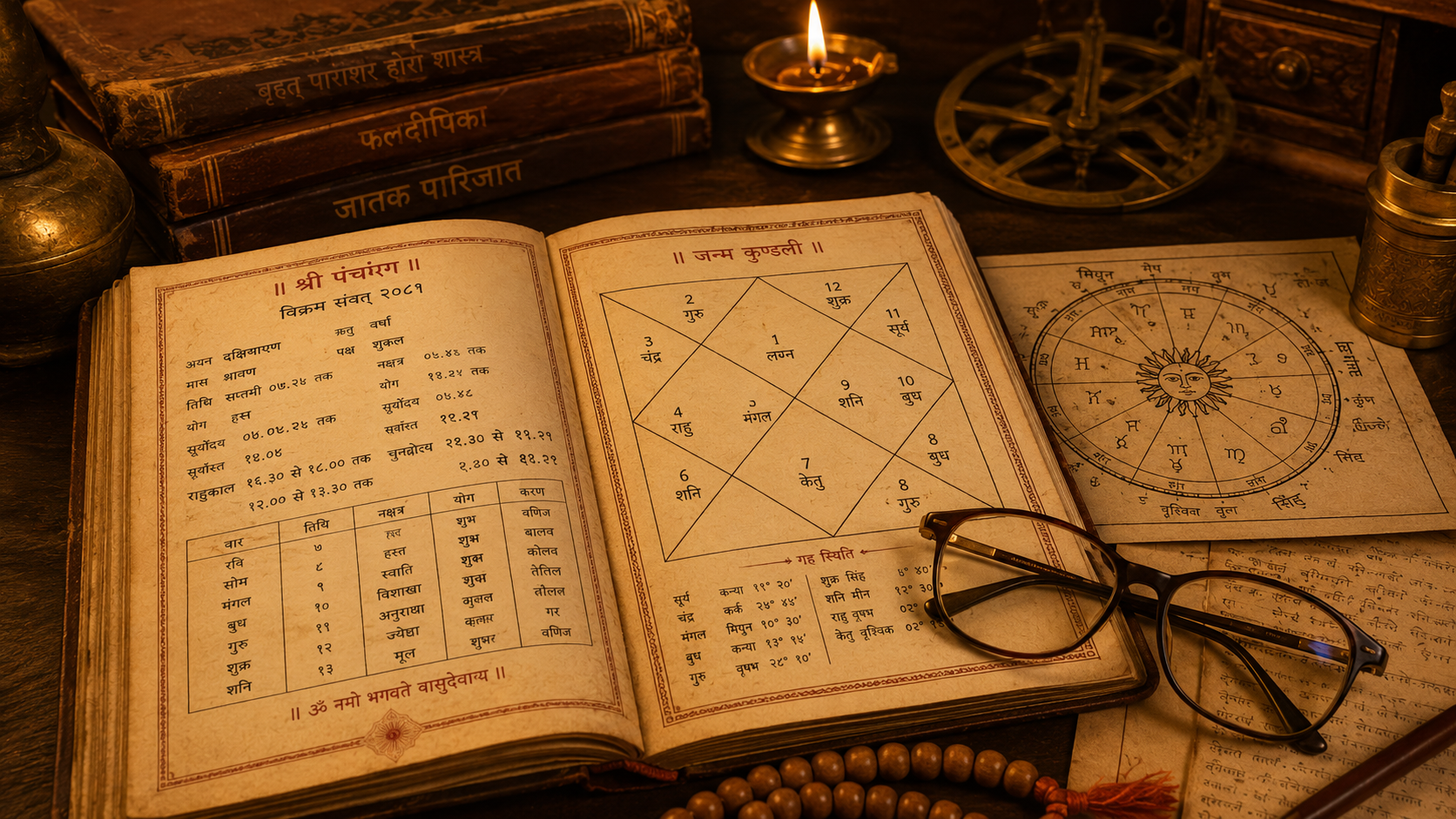
The panchang, a traditional almanac, is still consulted daily in many Indian homes.